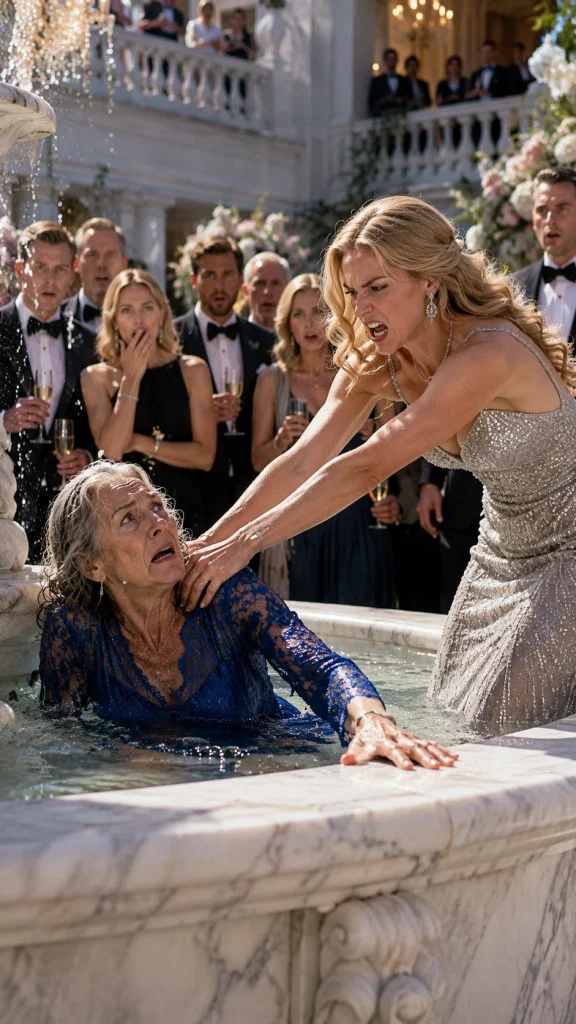
At our extravagant engagement party, I watched from the balcony as my fiancée deliberately pushed my mother into the decorative fountain. “Your cheap clothes are ruining my aesthetic,” she laughed with her wealthy friends. I did not shout. I calmly took out my phone and liquidated the $10 million trust fund I had just created for her. She thought she had secured a refined, old-money billionaire. She did not know my empire was born in the slums, and I knew exactly how to take away everything someone cherished.
The splash rose above the orchestra, but my fiancée’s laughter sliced through the ballroom like glass. From the balcony, I watched my mother come up in the marble fountain while two hundred guests pretended not to look.
Celeste Monroe stood at the edge in a silver gown worth more than the house I grew up in. “Your cheap clothes are ruining my aesthetic,” she said, loud enough for her friends to hear. They laughed behind jeweled hands.
My mother, Elena, gripped the fountain’s rim. Her blue dress was drenched, her gray hair stuck to her face. It was the same dress she had worn to my first business award, altered three times because she refused to let me buy her a new one.
I started down the stairs.
Celeste saw me and smiled, certain I would save her from embarrassment. “Adrian, darling, your mother slipped.”
My mother looked at me. She did not ask for help. She never had. Not when we slept above a laundromat with rats in the walls. Not when she cleaned offices at night so I could study. Not when men with gold watches told me boys from our neighborhood did not become owners.
I reached the fountain, removed my jacket, and wrapped it around her shoulders.
“Did you slip?” I asked.
“No,” she said softly.
The room fell silent.
Celeste rolled her eyes. “She was crowding the photographs. Honestly, Adrian, this party cost three million dollars. Standards matter.”
I met her eyes and felt something in me turn cold.
Three hours earlier, I had signed documents creating a ten-million-dollar trust in Celeste’s name, contingent on our marriage. It was meant to ensure her independence, though she had called it “a charming beginning.” The papers were still in my attorney’s secure portal.
I took out my phone.
Celeste brightened, assuming I was arranging damage control.
Instead, I messaged my chief counsel: Liquidate the trust assets. Revoke her interest. Begin full audit of Monroe Holdings. Quietly.
His reply came in twelve seconds.
Done.
I helped my mother stand. Celeste leaned close and whispered, “Do not make a scene. You know what my family can do to your reputation.”
I smiled because fear was the language she expected.
They mistook my tailored suits and measured voice for softness, never understanding that restraint was only the weapon I had learned to sharpen long before I owned a boardroom.
What Celeste did not know was that politeness had never made me rich. Patience had. Documentation had. And in the slums, where one mistake could cost a family everything, my mother had taught me never to strike until I knew exactly where the structure would collapse.
Part 2
Celeste spent the next morning posting photos from the party. In every picture, the fountain incident had been cropped out. Her caption praised “legacy, elegance, and family.” My mother was not mentioned.
By noon, Celeste arrived at my penthouse with her father, Victor Monroe, and three lawyers.
Victor remained standing. “Last night was unfortunate. Elena should accept a private apology and sign a confidentiality agreement.”
My mother, wrapped in a plain cardigan, looked at the document. “You want me silent because your daughter assaulted me.”
Celeste sighed. “Please stop using dramatic words.”
I poured coffee. “What happens if she refuses?”
Victor smiled. “Then certain investors may reconsider their confidence in your company.”
He believed his family still controlled the old-money banks funding my newest redevelopment project. He also believed my company needed their approval to survive. Ten years earlier, that might have been true.
I slid the agreement back. “We will consider it.”
Celeste kissed my cheek. “That is why I love you. You are reasonable.”
After they left, my mother stared at me. “You are not marrying her.”
“No.”
“Then why did you let them walk out smiling?”
“Because arrogant people reveal more when they think they are safe.”
The audit had already confirmed what I suspected. Monroe Holdings was not a thriving dynasty. It was a collapsing mansion freshly painted for guests. Victor had borrowed against nearly every property, shifted pension money between subsidiaries, and used Celeste’s charitable foundation for personal expenses.
Worse, their rescue depended on me.
Six months earlier, Victor had quietly approached my investment division for a two-hundred-million-dollar credit facility. He hid the request behind shell companies, assuming I would never review deals below my executive level. But I had grown up watching landlords hide ownership behind cousins and fake addresses. Shell games were familiar.
That evening, Celeste hosted a private dinner for wedding sponsors. She wore my grandmother’s emerald necklace, which I had lent her for engagement week.
She raised a glass. “Soon, Adrian’s world and mine will become one.”
“Not quite,” said Mara Chen, my chief counsel, entering with a sealed folder.